
How Can I Strengthen My Arches and Toes Without a Balance Board?
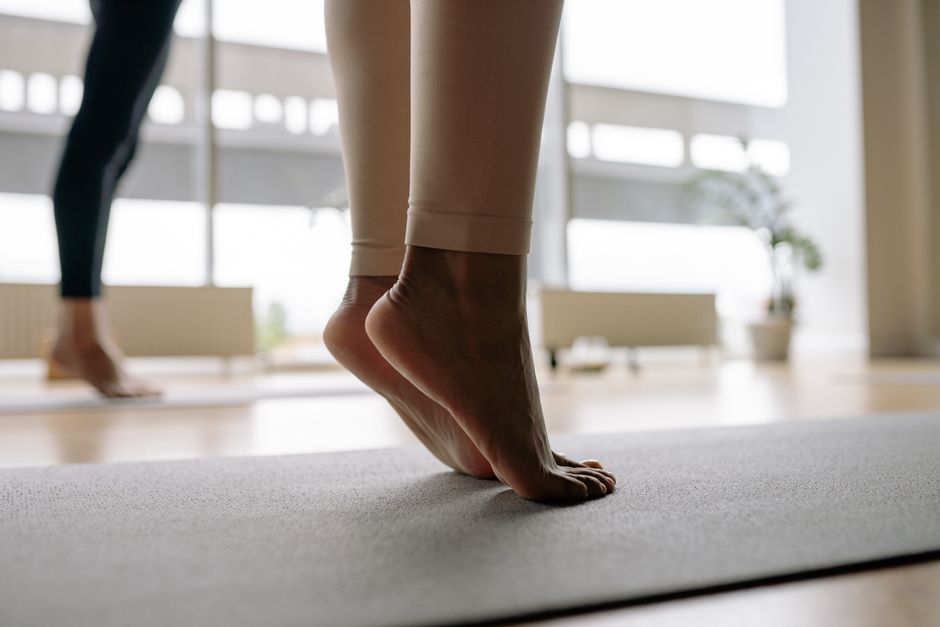
Build foot strength with short-foot holds, toe spreading, controlled toe curls, and supported calf raises. Start seated if standing work feels too demanding, keep the toes long during arch work, and progress only when the movement stays painless. Research supports intrinsic-foot-muscle training for strength and foot function, though it does not establish it as a pain cure.
What are the best exercises to strengthen the small muscles in my feet?
The best starting set is short-foot work, toe spreading, toe curls, and supported calf raises because each gives the foot a distinct job without requiring a balance board.
The small muscles inside the foot do not need spectacle. They need clean work. A 2024 systematic review in the Journal of Athletic Training reviewed 13 randomized controlled studies lasting at least 2 weeks. Intrinsic-foot-muscle training improved toe-flexion strength, balance, self-reported disability, navicular drop, and Foot Posture Index across the included evidence. It did not outperform control interventions for pain reduction.
That distinction matters. Stronger is not the same as pain-free. Function is one outcome. Pain has other causes.
| Movement | What the movement asks of the foot | Low-load starting position |
|---|---|---|
| Short foot | Draw the ball of the foot toward the heel while the toes stay extended | Seated with the foot flat |
| Toe spread | Open the toes apart, then let them rest without gripping | Seated with the foot flat |
| Toe curl | Gather a towel with the toes, then release fully | Seated |
| Calf raise | Rise through the forefoot with the heel lifting under control | Standing with chair or wall support |
For toe curls, the American Academy of Orthopaedic Surgeons foot and ankle conditioning program includes towel curls and marble pickup as seated toe work. The same program describes calf raises with chair or wall support, beginning on both legs and moving toward one leg when appropriate.
Do the movements slowly enough to tell which tissue is working. The point is not to make the foot tense. The point is to give it a clear task.
How do I do the short foot exercise without curling my toes?
Keep the toes extended and gently bring the ball of the foot toward the heel; curling the toes means the exercise has changed from arch activation into toe gripping.
Place the bare foot flat on the floor. Let the heel, ball of the big toe, and ball of the little toe stay in contact. Keep the toes long. Then make the middle of the foot shorter by drawing the first metatarsophalangeal joint, the joint at the base of the big toe, toward the heel.
Nothing dramatic needs to happen. The arch lifts a little. The toes do not claw. The heel does not slide.
A randomized clinical trial of 85 asymptomatic people with pronated foot posture used this same distinction: bring the first metatarsophalangeal joint toward the heel while keeping the toes extended. Its progression moved from seated short-foot work to loaded sitting, standing, and single-limb standing across 4 weeks. The study found no statistically significant between-group difference in foot posture, despite within-participant reductions in navicular-drop values. A foot exercise is training, not a guarantee.
Cramping is useful feedback. Stop the hold, relax the toes, reduce the effort, and try again with less force. A smaller clean contraction is the right version. A larger grip is a different movement.
A simple progression follows the evidence without making standing balance the main event:
- Learn the short-foot action seated with the knee bent and the foot flat.
- Repeat it seated with more body weight through the foot only when the toes stay long.
- Perform it standing while using nearby support.
- Add a single-leg version only when the standing version remains controlled and painless.
The 2024 Journal of Athletic Training review describes the short-foot exercise as the movement that raises the medial longitudinal arch without toe flexion. It also identifies short foot as the most effective intrinsic-foot-muscle exercise among the available exercises it compared.
Can weak foot muscles make my feet feel tired when I walk?
Weak foot muscles can be part of a tired-feet pattern, but fatigue while walking does not identify the cause on its own.
The research base supports a narrow claim. Intrinsic-foot-muscle training improves strength and measures of foot function. It does not prove that every tired foot comes from weak intrinsic muscles, and the 2024 review did not find superior pain reduction versus control interventions.
Older adults have a separate evidence base. A systematic review in the Journal of the American Geriatrics Society examined intrinsic-foot-muscle strengthening in ambulatory adults aged 65 years and older. It included 9 articles from a literature base of 1,674 participants. The review rated the evidence as fair quality and reported improvements in strength, balance, and mobility, while gait effects were small.
Seated practice is not a lesser version. It is a way to learn the pattern under less load. Standing work adds body weight. Single-leg work adds a balance demand. These are separate layers.
Exercise should not cause pain. AAOS says to speak with a doctor or physical therapist when pain occurs during exercise or when the prescribed frequency is unclear. A recent injury needs its own assessment; the supplied public sources do not set a safe exercise protocol for every recent foot or ankle injury.
Diabetes changes the safety check. The American Diabetes Association Standards of Care in Diabetes—2025 recommends annual comprehensive foot evaluation and annual 10-g monofilament testing for people with diabetes to identify feet at risk of ulceration and amputation. Open ulceration, unexplained swelling, redness, or increased skin temperature calls for urgent referral to a foot-care specialist or interprofessional team. Loss of protective sensation is not a problem to solve by pushing harder.
Foot training rewards attention. Foot gripping rewards repetition of the wrong task.
Frequently Asked Questions
How often should I do arch and toe-strengthening exercises?
The AAOS conditioning program states that its general program is continued for 4-6 weeks unless a clinician gives different guidance, then maintained 3-5 days per week. Its specific toe exercises and calf raises have their own frequencies, so the movement and a person's symptoms shape the schedule.
Are seated foot exercises useful if standing exercises hurt?
Yes. Seated work is a lower-load entry point used in published short-foot progressions before standing work. AAOS states that exercise should not cause pain; pain is a reason to speak with a doctor or physical therapist rather than push through.
Sources
- Journal of Athletic Training: Evidence for Intrinsic Foot Muscle Training in Improving Foot Function
- American Academy of Orthopaedic Surgeons OrthoInfo: Foot and Ankle Conditioning Program
- American Diabetes Association: Standards of Care in Diabetes—2025, Retinopathy, Neuropathy, and Foot Care
- Journal of the American Geriatrics Society: The Effects of Intrinsic Foot Muscle Strengthening on Functional Mobility in Older Adults
- International Journal of Environmental Research and Public Health: Randomized Clinical Trial: The Effect of Exercise of the Intrinsic Muscle on Foot Pronation
Disclaimer: This article is for general information only and is not medical advice. It is not a substitute for diagnosis or treatment by a qualified healthcare professional. Always speak to your doctor before acting on anything you read here.