
What Can I Eat for Breakfast to Get More Iodine?
Build breakfast around a measured, dependable source rather than treating seaweed as a shortcut: eggs, dairy, seafood, iodine-fortified plant drinks, and iodized salt can all contribute. For adults, the NIH Office of Dietary Supplements lists 150 mcg per day as the recommended dietary allowance (accessed 2026); plant-based eaters need label checks because many milk alternatives supply very little iodine and seaweed can supply far more than expected.
What can I eat for breakfast to get more iodine?
Choose one dependable iodine source, then build the rest of breakfast around it. That lowers the cognitive load: you are not trying to calculate every oat, berry, or slice of toast. You are making the iodine-bearing item visible.
For a dairy-inclusive breakfast, the NIH Office of Dietary Supplements lists 84 mcg for 1 cup of nonfat milk and 87 mcg for 3/4 cup of plain nonfat Greek yogurt (accessed 2026). For a seafood breakfast, the same NIH table lists 146 mcg for 3 ounces of baked cod (accessed 2026). Those are concrete anchors, not vague promises.
| Breakfast anchor | Iodine listed per serving | What it changes |
|---|---|---|
| Nonfat milk, 1 cup | 84 mcg, NIH Office of Dietary Supplements, accessed 2026 | Creates a dairy-based base for cereal or oats. |
| Plain nonfat Greek yogurt, 3/4 cup | 87 mcg, NIH Office of Dietary Supplements, accessed 2026 | Provides a dairy option without relying on seaweed. |
| Baked cod, 3 ounces | 146 mcg, NIH Office of Dietary Supplements, accessed 2026 | Nearly matches the adult daily allowance listed by NIH. |
| Iodized table salt, 1/4 teaspoon | 78 mcg, NIH Office of Dietary Supplements, accessed 2026 | Works only when the package specifically says iodized. |
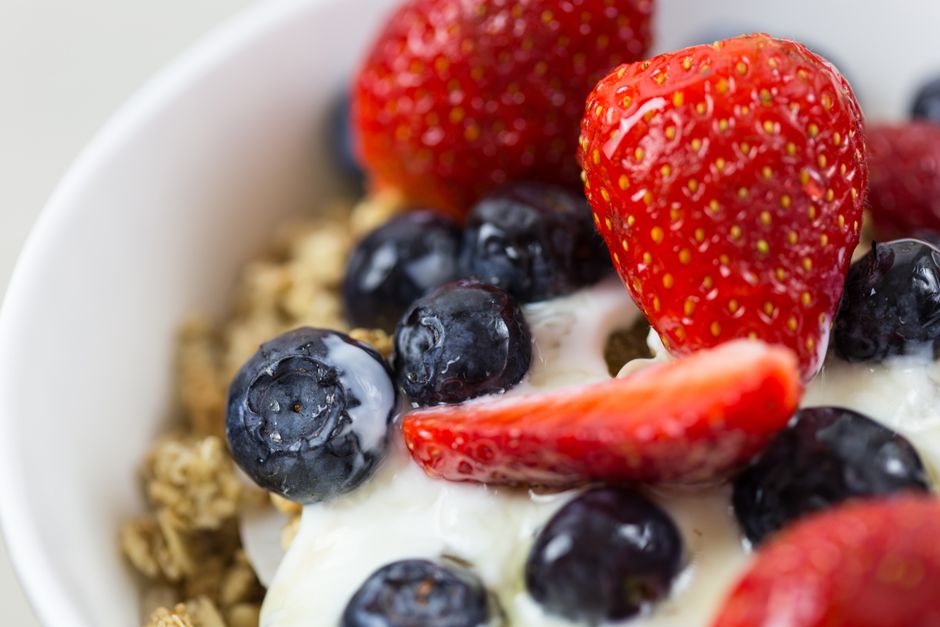
The breakfast-combination rule: pair a known source with the meal you already eat. A yogurt breakfast can include fruit and grains. A savory breakfast can include eggs or fish and salt that is explicitly labeled iodized. The source supplies the iodine; the rest makes the meal workable.
For people limiting dairy, the gap is not a failure of plant-based eating. It is a sourcing problem. The NIH notes that seafood, eggs, milk, and milk products are among the better sources, so removing several of them at once makes label-reading more important. If seafood is part of your diet, it is also worth reading How Can I Manage a Gout Flare at Home and Know When It Is Urgent? when navigating food choices around a gout flare.
Are eggs enough iodine for breakfast?
No. Eggs contribute iodine, but eggs alone are unlikely to cover an adult's full daily iodine target.
A large hard-boiled egg provides 31 mcg, or 21% of the 150 mcg Daily Value, according to the NIH Office of Dietary Supplements (accessed 2026). That makes eggs useful contributors, not a one-item plan. Two eggs increase the contribution, but the underlying point stays the same: use eggs as part of a breakfast pattern, not as proof that iodine is handled.
Weak plan: “Eggs have iodine, so breakfast is covered.” Strong plan: “Eggs are the anchor, and the rest of the day still needs a reliable iodine source.” The stronger version avoids false precision and keeps seaweed from becoming the default backup.
This matters more during pregnancy and lactation. The NIH Office of Dietary Supplements lists 220 mcg per day during pregnancy and 290 mcg per day during lactation (accessed 2026), compared with 150 mcg for adults. Those figures describe population recommendations, not a personalized meal prescription; individual needs and medical context can change the conversation.
Do plant milks contain iodine?
Some plant milks contain added iodine, but many do not, so the package label is the deciding document.
The NIH Office of Dietary Supplements lists about 3 mcg for 1 cup of soy beverage and notes that food labels are not required to list iodine unless it has been added (accessed 2026). That is the label-reading trap: a Nutrition Facts panel can look complete while telling you nothing useful about iodine.
A peer-reviewed study in Thyroid measured 30 milk-alternative products from 16 companies and found an average of 3.1 mcg per 250 mL, roughly 1 cup (2016). The authors concluded that the tested alternatives contained far less iodine than cow's milk. Translation: “plant-based” and “fortified” are separate questions.
Run the label check in this order: look for iodine in the nutrients or ingredients information; confirm that it was added rather than assumed; then compare the listed serving size with the amount you actually pour. The NHS makes the same operational point: some soy and oat drinks are fortified with iodine, and consumers need to check the label (accessed 2026).
Is sea salt the same as iodized salt?
No. Sea salt is not the same as iodized salt, and its name does not confirm any iodine content.
The NIH Office of Dietary Supplements lists 78 mcg for 1/4 teaspoon of iodized table salt, while noniodized sea salt provides 0 mcg for the same amount (accessed 2026). It also states that specialty salts, including sea salt, kosher salt, Himalayan salt, and fleur de sel, are not usually iodized. The replacement behavior is simple: check for the word “iodized” instead of using color, origin, or marketing language as a proxy.
Seaweed needs an even tighter boundary. A 2021 Nutrients analysis of 96 commercially available macroalgae products found 128 to 62,400 mcg of iodine per serving in whole-food macroalgae products. It also found that 54 products exceeded the tolerable upper intake level in one portion or dose. The range is the warning: seaweed is not a calibrated breakfast tool.
If thyroid concerns are part of the picture, high iodine doses over long periods can affect thyroid function, according to the NHS (accessed 2026). That is a reason to use a clinician or qualified dietitian for individualized guidance, especially when diet restrictions and thyroid history overlap.
Frequently Asked Questions
Can I get too much iodine from seaweed snacks?
Yes. A 2021 Nutrients analysis found that iodine per serving in whole-food macroalgae products ranged from 128 to 62,400 mcg, and 54 tested products exceeded the tolerable upper intake level in one serving or dose. The researchers concluded that macroalgae-containing products can be unreliable sources and may create a risk of excessive iodine intake.
What are iodine-rich breakfast options if I do not eat dairy?
The NIH Office of Dietary Supplements lists a large hard-boiled egg at 31 mcg, 3 ounces of baked cod at 146 mcg, 2 tablespoons of dried nori flakes at 116 mcg, and 1/4 teaspoon of iodized table salt at 78 mcg (accessed 2026). For a dairy-free breakfast, the practical move is to combine foods with known amounts and verify whether any plant drink is iodine-fortified.
Do I need extra iodine if I am vegan?
The NHS states that people following a strict vegan diet who do not eat fish, eggs, cow's milk, or other dairy may want to consider iodine-fortified foods or an iodine supplement (accessed 2026). This is a diet-pattern question, not an automatic conclusion: the key variables are the fortified foods used and the rest of the diet.
This week's drill: inspect the salt and plant-drink labels in your kitchen. Write down whether each is explicitly iodized or iodine-fortified. That one check replaces guesswork with a usable breakfast plan.
Sources
- NIH Office of Dietary Supplements: Iodine Health Professional Fact Sheet
- Thyroid: Iodine Concentration of Milk-Alternative Drinks Available in the UK
- Nutrients: Iodine Content of Macroalgae Products
- NHS: Iodine
Disclaimer: This article is for general information only and is not medical advice. It is not a substitute for diagnosis or treatment by a qualified healthcare professional. Always speak to your doctor before acting on anything you read here.